
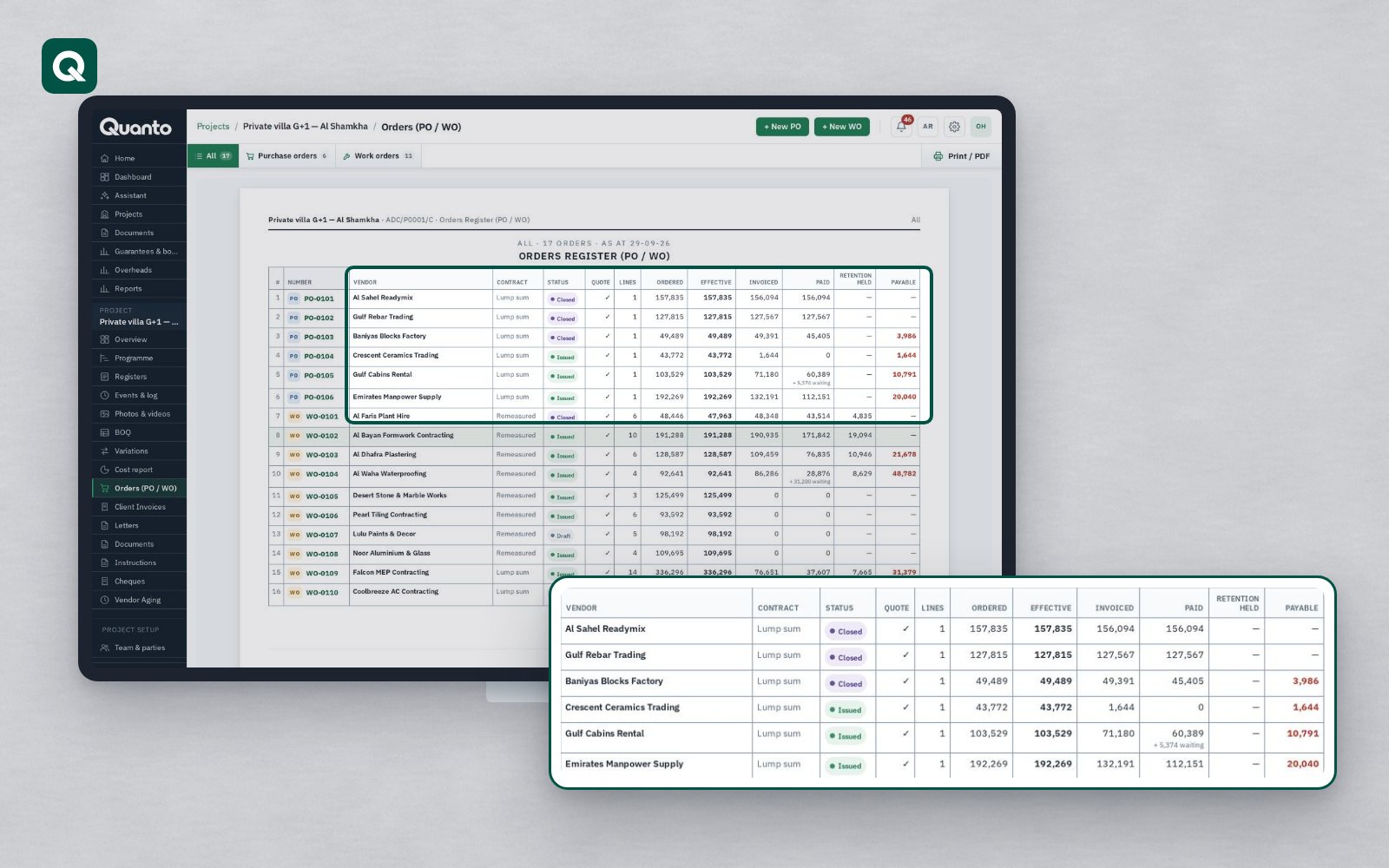
On most building projects, a large share of the work is done by subcontractors and a large share of the cost is materials. That makes procurement and subcontract management one of the places where a contractor's margin is won or lost.
Where it usually goes wrong
- Orders are placed by phone or message, and the price is agreed later.
- Subcontract retention is deducted but its release date is forgotten, on both sides.
- A subcontractor's trade licence or insurance expires in the middle of the job and nobody notices.
- Invoices arrive without a clear link to an order, so nobody knows what was really agreed.
- Payments to suppliers are released before the work or delivery has been approved.
Orders with their paperwork
In Quanto Management (Professional and above), purchase orders (materials) and work orders (subcontracts) are numbered automatically, and each one is booked against a cost code, so it appears in the project's committed cost the day it is issued.
- A vendor quotation must be attached before an order can be issued.
- Each order carries its payment terms.
- Work orders carry retention with its release date.
- Purchase orders carry warranty terms.
Invoices and payments in order
Vendor invoices are recorded with their due dates. Payments are released after approval. Vendor aging shows what is due, what is overdue and to whom. Because every invoice belongs to an order and every order to a cost code, the actual cost on the cost report is always traceable to its source.
A work order for plastering worth AED 600,000 carries 10% retention, half released at completion and half at the end of the defects period. Quanto keeps both release dates, so the AED 30,000 tranches are neither forgotten by the contractor's accounts nor chased late by the subcontractor.
A subcontractor register that warns you
The subcontractor register keeps each company's licence and insurance expiry dates. An expiring insurance policy is flagged before it lapses, not discovered after an incident on site. Guarantees and bonds also carry expiry alerts.
Subcontractors on the project, for their part only
Subcontractors can be invited to the project, and they join free. They work on their own part: their submittals, method statements and the items waiting on them. Contractor-only information such as costs, margins and other suppliers stays private.
The result
Procurement stops being a set of phone calls and starts being a record: what was ordered, at what price, on what terms, what has been delivered and invoiced, and what is still to pay or release.
Tomorrow: the programme, with planned, earned and actual progress.
Follow Quanto for a new article every day: LinkedIn · X · YouTube · Instagram · Facebook