Every contractor tracks cost. The question is whether the numbers can be trusted, and whether they arrive in time to change anything. A cost report assembled at month end from accounting exports and site spreadsheets tells you what already happened. It rarely tells you what is about to happen.
Why cost reports mislead
- Actual cost lags. Invoices arrive weeks after the work. By the time the cost is booked, the overrun is old news.
- Commitments are invisible. An order placed today is not in the accounts until it is invoiced, but the money is already spent.
- Budget and contract drift apart. Variations change the contract value, but the budget stays at tender level.
- Different files, different numbers. The QS, the project manager and accounts each have their own version.
One line per cost code
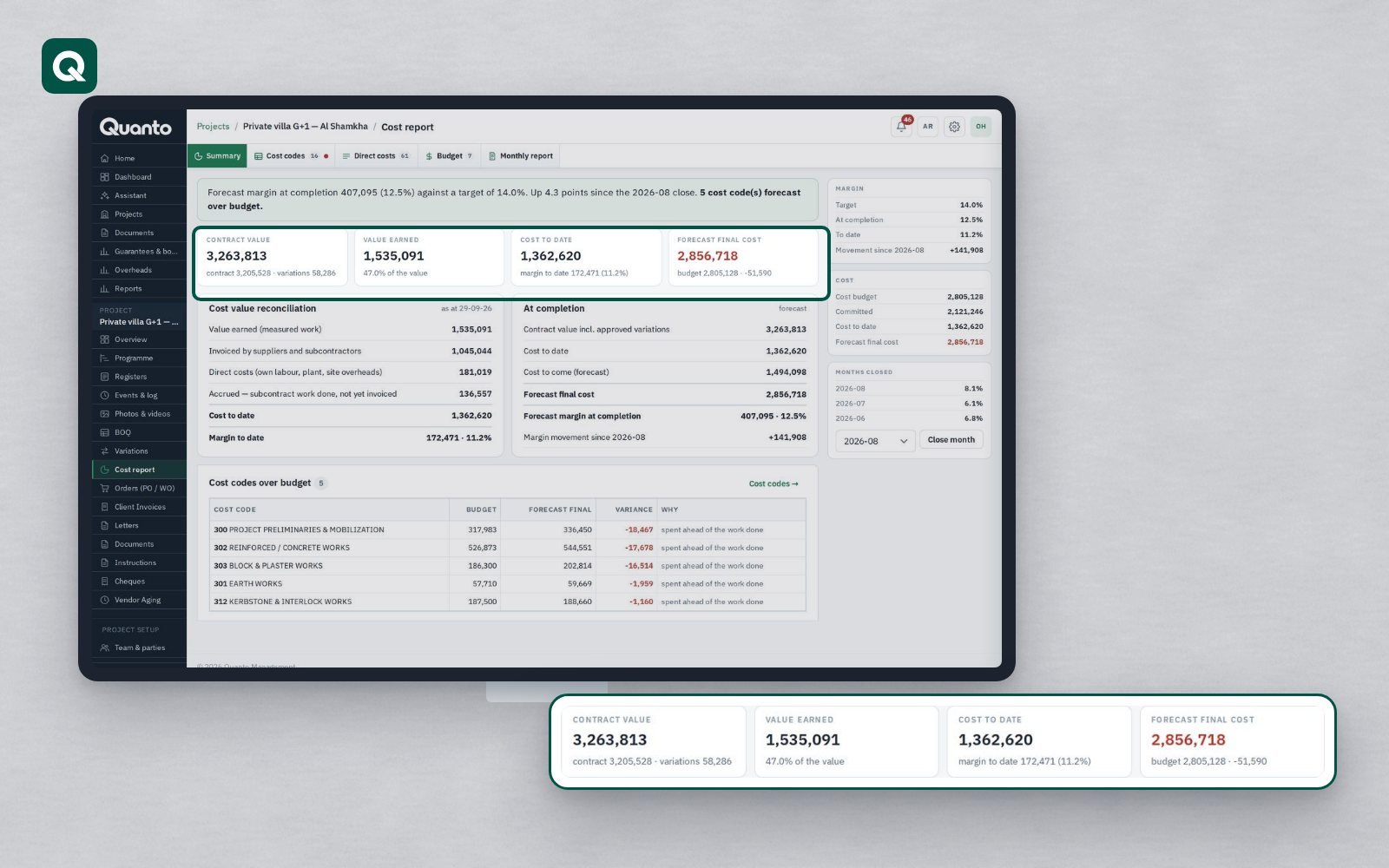
In Quanto Management, every BOQ line carries its cost code, and every order and cost is booked against a cost code. That gives one line per cost code with:
- Contract value: what the client pays for this scope, including approved variations;
- Budget: what you planned to spend;
- Committed: what is already ordered;
- Actual: what is already invoiced or spent;
- To order: what is still to be bought.
From these comes the expected final cost and margin, per project and across the company.
| Cost code: blockwork | AED |
|---|---|
| Budget | 1,200,000 |
| Committed (orders placed) | 1,050,000 |
| Actual (invoiced) | 620,000 |
| Still to order (35% of the scope) | 420,000 |
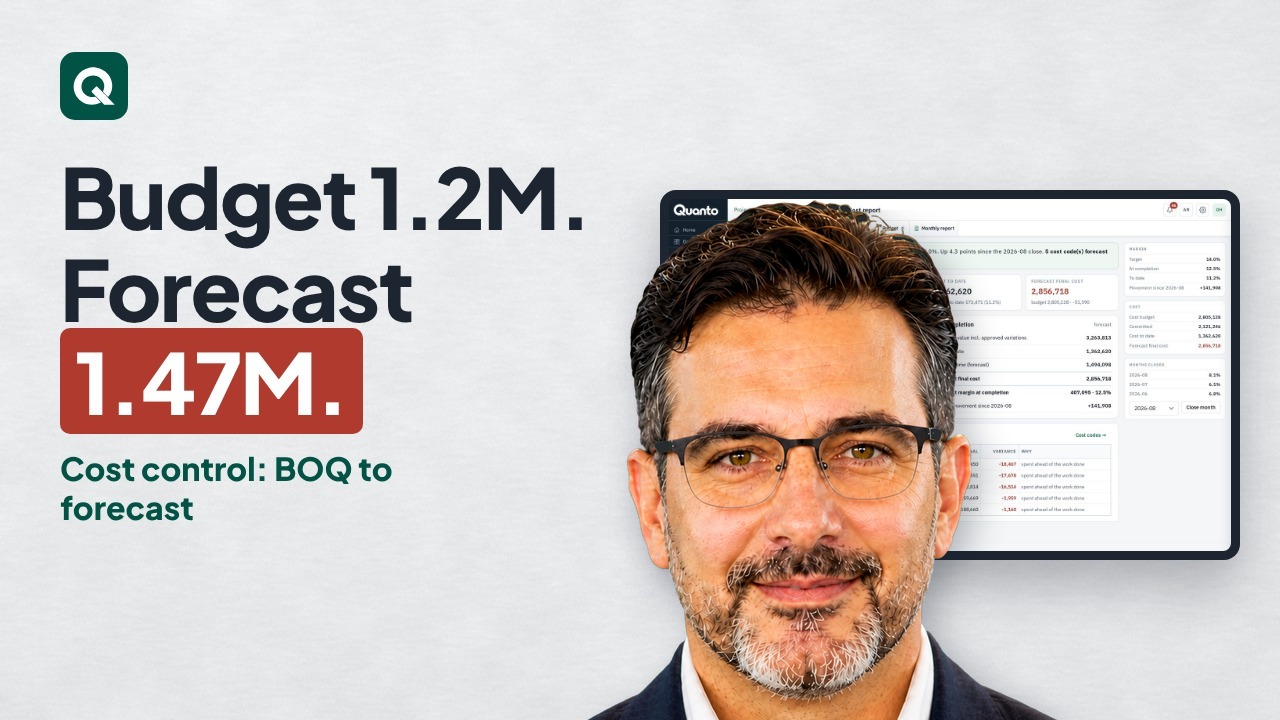
| Expected final cost | 1,470,000 |
Actual cost alone looks comfortable. Committed plus still to order shows an overrun of AED 270,000 while most of the work is still ahead and the next orders can still be negotiated.
Controls at the point of spending
- A vendor quotation must be attached before a purchase order or work order can be issued.
- Orders carry payment terms; work orders carry retention with its release date; purchase orders carry warranty terms.
- Vendor invoices have due dates; payments are released after approval; vendor aging shows what is due.
Cash, not only cost
A profitable project can still run out of cash. Quanto shows money in and out by month, and the months that need funding. Cheques issued and received, guarantees and bonds with expiry alerts, and company overheads are kept in the same place.
Private by design
Cost, margin, suppliers and cheques are contractor-only information. They are never shown to the owner or the consultant, even though both work on the same project.
Tomorrow: subcontractors and procurement, with approvals, orders and retention.
Watch: this article in 104 seconds
This article on social media: LinkedIn · X · Instagram · YouTube Shorts · Facebook
Follow Quanto for a new article every day: LinkedIn · X · YouTube · Instagram · Facebook