
Monday morning on a hotel project. The facade subcontractor's crew is on the scaffold, fixing brackets on the east elevation. The Engineer's inspector walks past, stops and asks for the subcontractor's approval. The site manager calls the office. The approval package was sent five weeks ago and is still "under review". Procurement issued the work order anyway, because the programme was tight. By noon the Engineer has written to the contractor and the crew is off the scaffold.
What it costs
Most contracts require the Engineer's or the employer's consent before part of the works is subcontracted. Starting without it gives the Engineer a reason to stop the work, to reject what was installed, or to refuse the subcontractor altogether. Meanwhile the subcontractor has mobilised against a signed work order, and expects to be paid for standing time.
The facade work order is worth AED 1,200,000. The crew stands down for nine days while the approval is completed, and the subcontractor claims AED 54,000 for idle labour and scaffold. The contractor cannot pass that cost on, because the delay was its own.
How it is usually handled
- The approval package goes to the consultant by email, and its status lives in one engineer's inbox.
- Procurement and the site do not see the same list, so a work order can be issued while approval is still pending.
- Comments from the consultant arrive weeks later, and nobody is sure whose move it is.
- The subcontractor's trade licence and insurance dates sit in a spreadsheet that nobody checks before mobilisation.
Each department does its part correctly. The failure is that nobody sees the whole picture on the day the crew arrives.
How Quanto Management handles it
In Quanto, each subcontractor has an approval sheet that records the Engineer's consent. The site team, procurement and the commercial team look at the same record, so the question "are they approved?" has one answer.
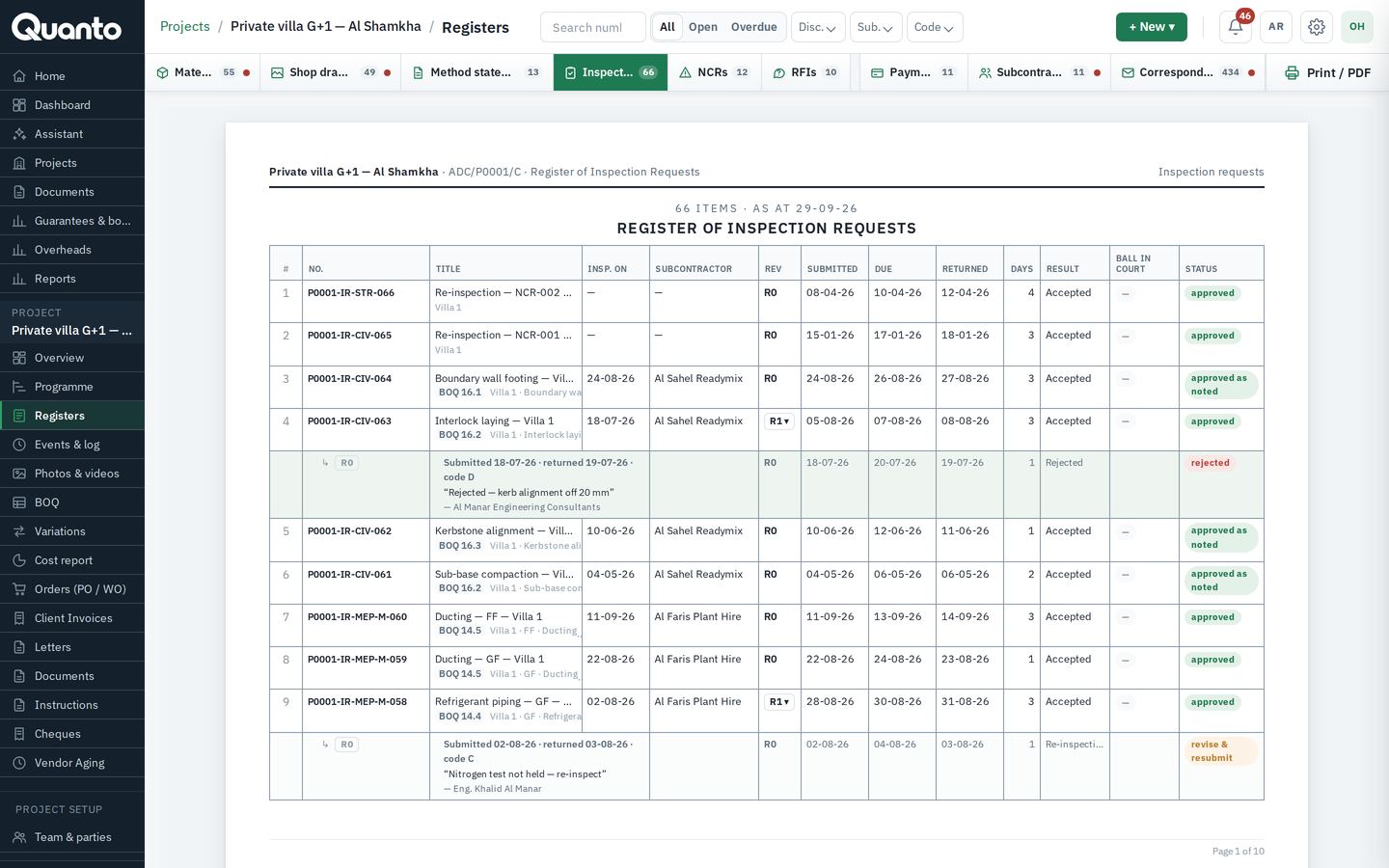
- The submissions that go with the approval, such as method statements and material submittals, are tracked in the registers with revisions, review codes, ball in court and due dates.
- The subcontractor register keeps each company's licence and insurance expiry dates, and an expiring policy is flagged before it lapses.
- In Professional and above, the work order is numbered automatically, booked to a cost code and cannot be issued without a vendor quotation attached. It carries its payment terms and its retention with the release date.
- Subcontractors can be invited to the project free. They work on their own submittals and the items waiting on them, while the contractor's costs and margins stay private.
- Reminders arrive two days before a due date and when it is missed, with a morning email summary.
Because the approval, the submittals and the work order sit on one project, a crew mobilising early is a visible exception, not a surprise found by the inspector.
A short checklist
- Submit the subcontractor approval as soon as the subcontractor is chosen, not when the work is due to start.
- Check approval status before the crew mobilises, not after.
- Make "approved by the Engineer" a condition in your own process for issuing the work order.
- Check licence and insurance expiry dates against the whole period of the subcontract.
- Record the date the approval was submitted and chase it against the review period in the contract.
- Tell the site team, in writing, which subcontractors are approved for which works.
Tomorrow: overspend seen too late.
Follow Quanto for a new article every day: LinkedIn · X · YouTube · Instagram · Facebook