
The interim payment application for month nine went to the Engineer on the 3rd. On day 20 the quantity surveyor calls and hears that it is "under review". On day 30 he sends a WhatsApp message. On day 45 the certificate arrives, with AED 600,000 held against three lines and one word of explanation: "pending". Meanwhile, the subcontractors' invoices for the same month are due, and the bank wants to know why the overdraft has grown.
What it costs
A late certificate pushes the payment back by the same number of days, sometimes more. Under the FIDIC 2017 Red Book, the Engineer issues the Interim Payment Certificate within 28 days after receiving the Statement and supporting documents (Sub-Clause 14.6), and the employer pays within 56 days after the Engineer receives them (Sub-Clause 14.7). Late payment carries financing charges under Sub-Clause 14.8. Your contract may set different periods, so read it first.
None of that helps unless you can show the dates: when the Statement was received, when the certificate was due, and when it was issued.
An application of AED 2,400,000 is certified 17 days late, and AED 600,000 is held without line-by-line reasons. The contractor funds the gap from an overdraft for the month and pays subcontractors late, which costs goodwill as well as interest.
How it is usually handled
- The application goes as a PDF by email. Whether and when the Engineer received the supporting documents becomes a matter of opinion.
- The certifying and payment dates are tracked in an Excel sheet that only the quantity surveyor opens.
- Chasing happens by phone and WhatsApp, so there is no formal record that the delay was raised.
- Held amounts are agreed in a meeting, and the reasons are never written against the lines.
When the dispute comes, the contractor has the feeling of being paid late, but not the record of it.
How Quanto Management handles it
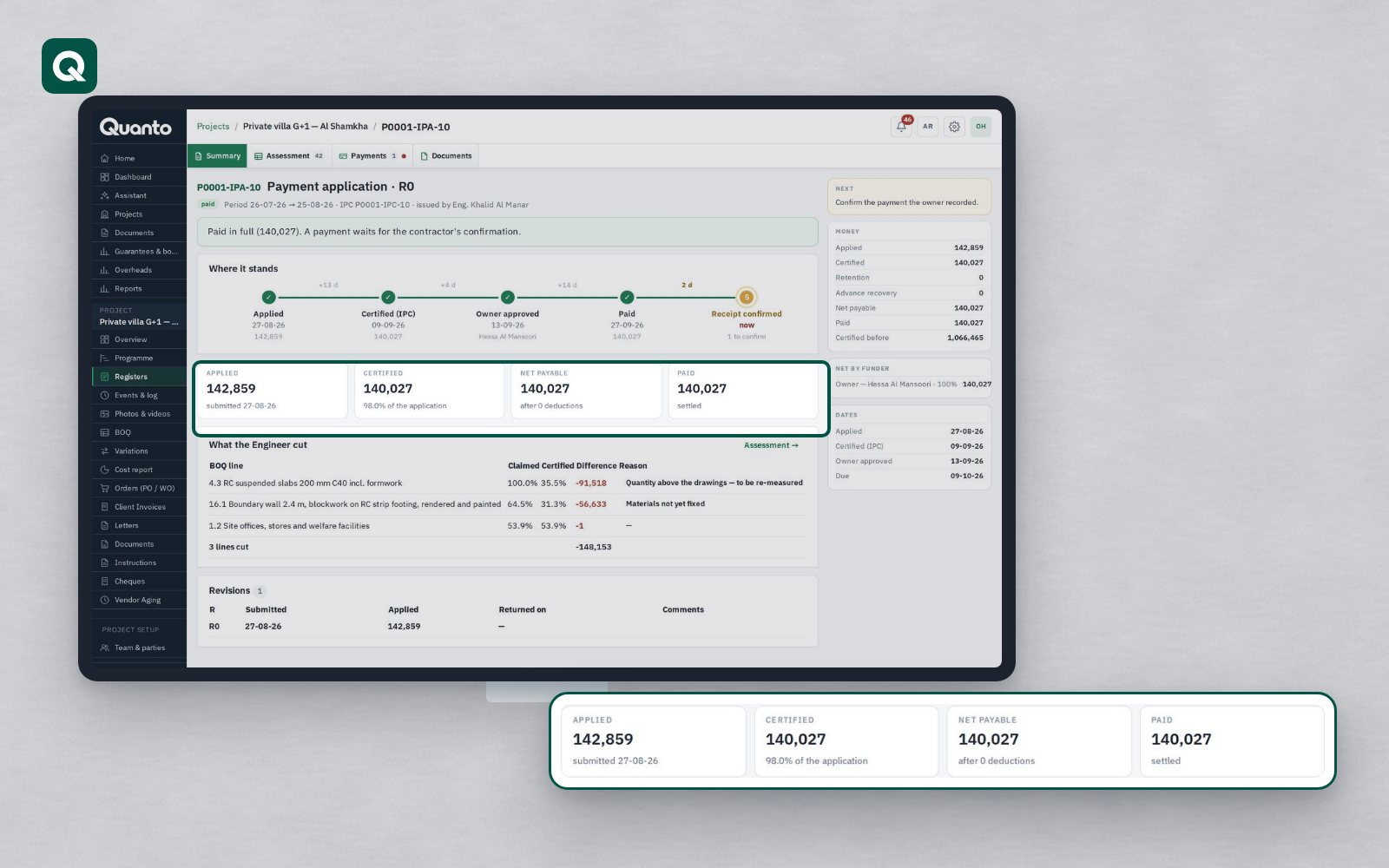
In Quanto (Professional and above), progress is entered by BOQ line for each valuation period and the payment application builds itself from it. The Engineer certifies line by line, with reasons for any amount held, and the owner approves where the contract requires it. Owner payments are recorded and confirmed.
- Every step is dated: submitted, certified, approved, paid.
- The periods of your form of contract, including the time the Engineer has to certify and the owner has to pay, are counted on the project calendar, with what silence means, such as interest due.
- Each party sees the clocks that apply to them on their own home page.
- Reminders arrive two days before a deadline and when it is missed.
- Retention, advance recovery, materials on site and amounts held for open NCRs are shown separately, not buried in a total.
- Cash flow shows money in and out by month and the months that need funding.
If you need to put the delay on record, the letter goes out on your letterhead with your reference numbering. Parties on Quanto receive it with a read receipt and a reply-by date.
A short checklist
- Get a dated receipt for every application and its supporting documents.
- Write the certifying and payment due dates on the application the day you submit it.
- Ask for written reasons, line by line, for every amount held.
- Raise a late certificate by letter, not only by phone or message.
- Read what your contract says about delayed payment, financing charges and the steps open to you.
- Update your cash flow the day a certificate is late, not at month end.
Tomorrow: missing daily reports.
General information only. Periods and procedures depend on the form of contract and its particular conditions; always check your own contract.
Follow Quanto for a new article every day: LinkedIn · X · YouTube · Instagram · Facebook