
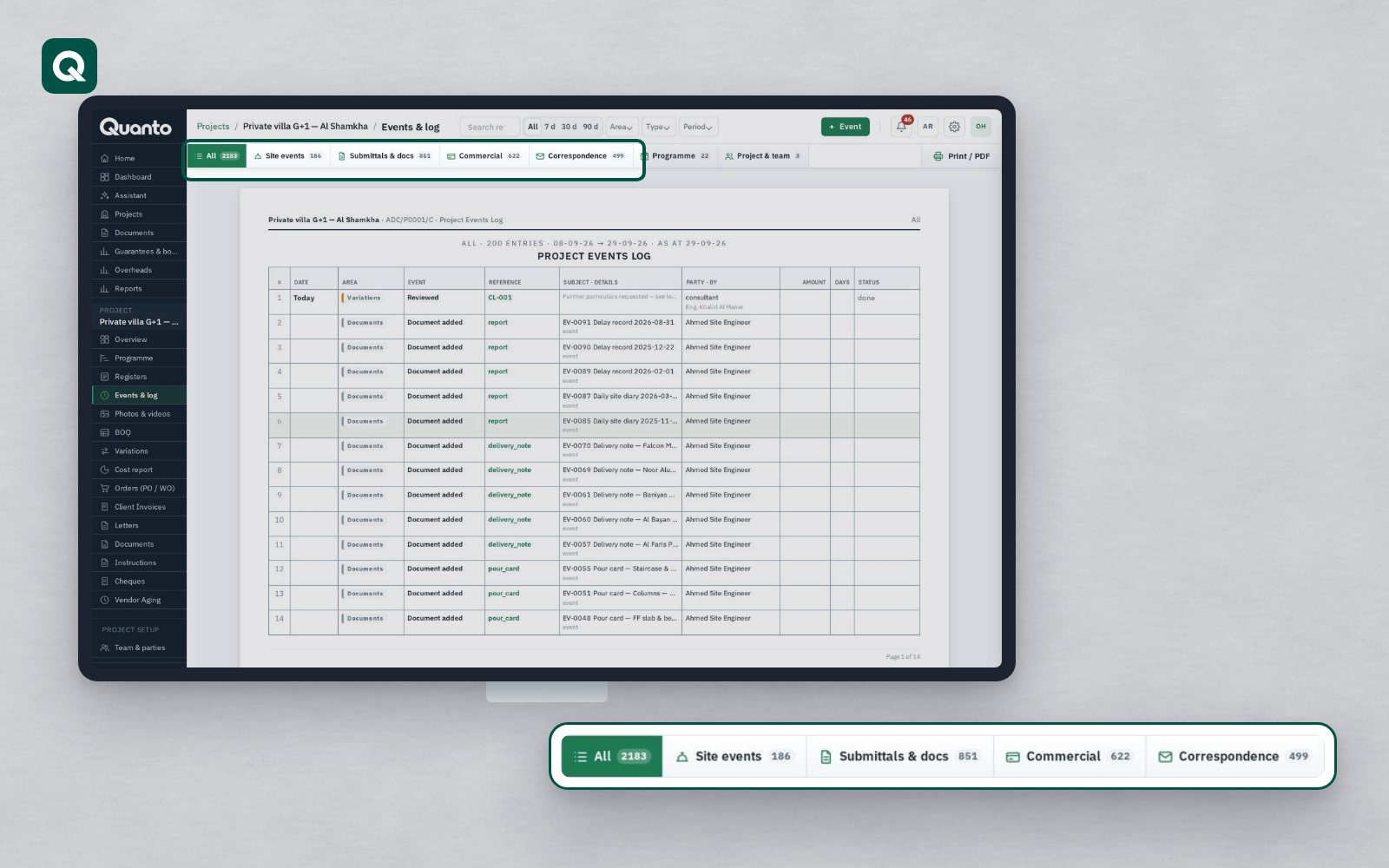
A typical building project produces thousands of records: letters, instructions, submittals, inspection requests, daily reports, photos, payment applications, minutes of meetings. Each one matters at some point. Most of them are kept in a way that makes them hard to find when that point comes.
Where the information goes
- Email. Important decisions sit in one person's inbox, mixed with everything else. When that person leaves the company, the context leaves with them.
- WhatsApp groups. Instructions, photos and approvals are exchanged quickly, which is good, and never filed, which is not. Months later nobody can search them properly or prove when something was sent.
- Spreadsheets. Every register lives in its own file: one for submittals, one for RFIs, one for variations. Versions multiply. Nobody is sure which file is current.
- Paper and local drives. Signed copies in site cabins, scans on a laptop, drawings in a folder only the document controller understands.
- People. The biggest store of project information is memory, and staff move between projects and companies all the time.
What it costs
Lost information rarely shows up as a line in the accounts. It shows up later, as:
- a claim that cannot be supported because the delay was never recorded on the day it happened;
- a variation that was carried out but cannot be priced because the instruction cannot be found;
- hours spent by engineers rebuilding a chronology from emails instead of running the job;
- a final account that takes months longer than it should, because both sides argue about the facts first.
An engineer who spends one day a week searching for, re-typing or reconciling records loses about 20% of the working week. Across a team of ten on a large project, that is the time of two people, every week, for the life of the project.
One record, shared by the parties
The answer is not another folder structure. It is one record per project, kept in one place and shared by the parties who run it. In Quanto Management:
- the owner, the consultant and the contractor work on the same project, each with access by party and level (view, edit, approve);
- letters, submittals, inspection requests, RFIs, NCRs, variations, claims and payments are all registers of the same project, linked to each other;
- photos and videos are tagged by area and linked to the events, BOQ lines, variations and letters they belong to;
- a project log records every action automatically, so the chronology builds itself.
The project log: the project's permanent memory
Every action in Quanto, such as a letter issued, an inspection requested, a payment certified or a drawing revised, is written to the project log with who did it and when. Nothing is silently deleted; changes are logged. When someone joins the project halfway through, they read the log instead of asking around. When a dispute starts, the chronology is already there.
When people move on
Staff changes are a fact of construction. With one shared record, the information belongs to the project, not to the person who happened to receive it. The new project manager opens the same registers, the same letters and the same log as the one who left.
In the next article we look at the most immediate benefit of keeping everything in one place: the time it gives back to the team.
Watch: this article in 85 seconds
This article on social media: LinkedIn · X · Instagram · YouTube Shorts · Facebook
Follow Quanto for a new article every day: LinkedIn · X · YouTube · Instagram · Facebook