
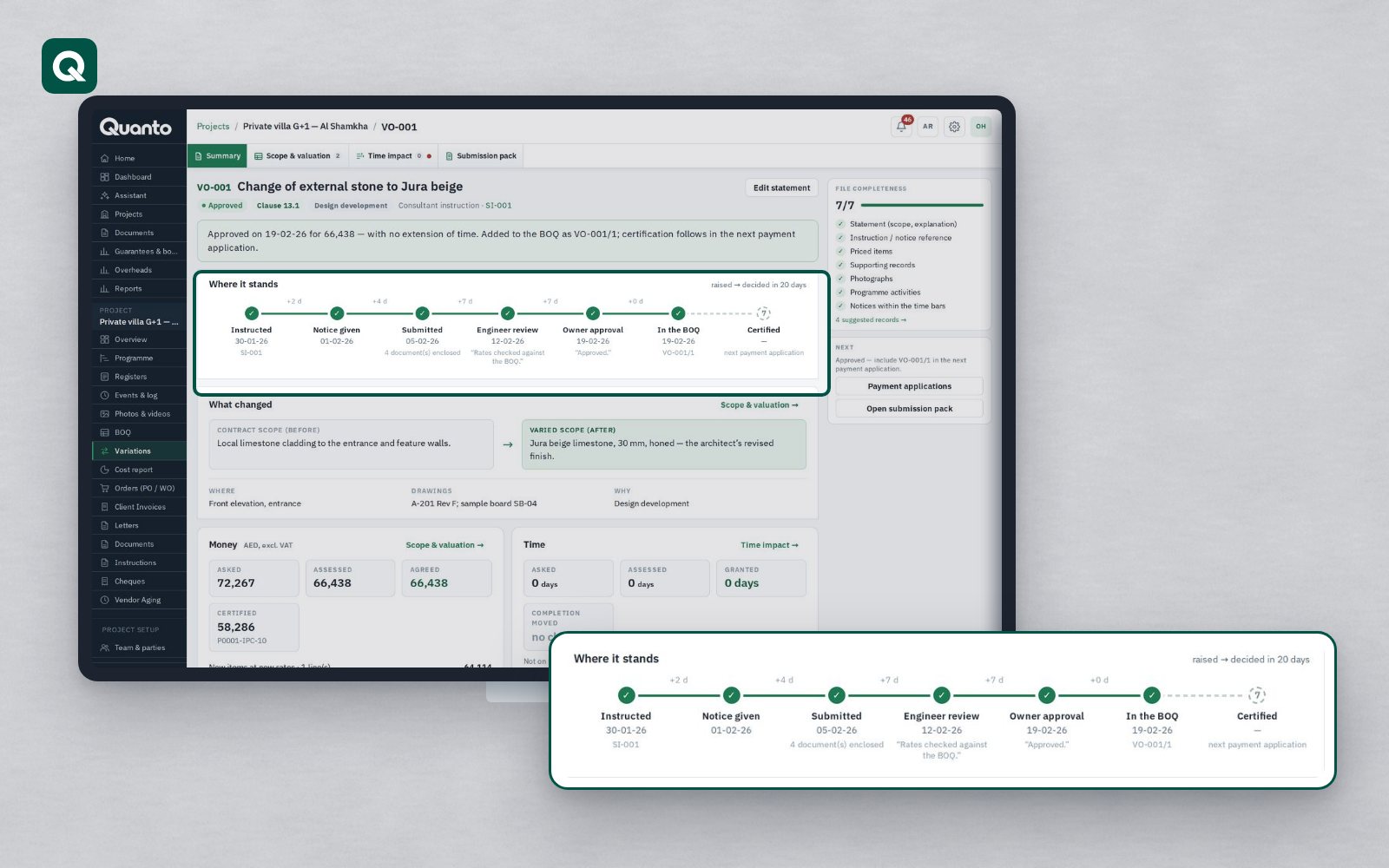
Construction contracts are full of clocks. A notice must be given within a set number of days. A reply is due within a set number of weeks. A payment must be made by a certain date. When a clock runs out, something happens automatically: a claim is time-barred, a submission is deemed approved or rejected, or interest becomes due.
The trouble is that nobody can hold dozens of running clocks in their head, across several projects, each under a different form of contract.
Every form has its own periods
Some examples:
- FIDIC 2017 Red Book: Notice of Claim within 28 days (20.2.1) and a fully detailed claim within 84 days (20.2.4). If not, the claim is time-barred. The Engineer's determination is due within 42 days (3.7.3), or it is deemed rejected.
- FIDIC 1999 Red Book: notice within 28 days and a detailed claim within 42 days (20.1).
- NEC4 ECC: a compensation event notified within 8 weeks (61.3); the Project Manager replies within 1 week, then 2 more weeks after a reminder (61.4), or it can be deemed accepted.
- JCT 2024 SBC: notice of delay forthwith (2.27.1); the Architect/Contract Administrator decides within 12 weeks (2.28.2).
- VOB/B: Behinderungsanzeige without delay (§ 6 Abs. 1); additional work announced before it starts (§ 2 Abs. 6); final payment within 30 days (§ 16 Abs. 3).
Each form also counts time differently: calendar days, weeks or working days, with or without public holidays.
How Quanto counts them
When you set up a project, you choose the form of contract: FIDIC 2017 Red, Yellow or Silver Book, FIDIC 1999 Red Book, NEC4 ECC, JCT 2024 SBC or VOB/B 2016. Quanto loads every period and time bar of that form and counts them on your project's calendar. Where your Particular Conditions differ, you change the period for that project. Other editions and bespoke contracts start from a set of values you edit period by period.
- Each clock shows its clause and who must act by when.
- Each clock shows what silence means: time-barred, deemed approved, deemed rejected or interest due.
- Clocks appear on the project's clocks page and on every variation and claim they belong to.
- Reminders arrive two days before the deadline and when it is missed, with a morning email summary.
Clocks for every party
Deadlines are not only the contractor's problem. The Engineer has periods to respond, determine and certify. The owner has periods to pay. Because the owner, the consultant and the contractor share one project, each party sees the clocks that apply to them on their own home page. A deemed approval is not a surprise when everyone saw the clock running.
From remembering to seeing
Missing a deadline is rarely negligence. It is usually an overloaded team juggling too many dates in too many places. A contract clock you can see, with its clause and its consequence, turns a memory test into a routine task.
Tomorrow: payments, from progress on site to a certified payment.
Watch: this article in 101 seconds

This article on social media: LinkedIn · X · Instagram · YouTube Shorts · Facebook
General information only. Periods and procedures depend on the form of contract and its particular conditions; always check your own contract.
Follow Quanto for a new article every day: LinkedIn · X · YouTube · Instagram · Facebook