
The monthly programme update shows the level 4 slab finishing 19 days late. Everyone on site knows why. The sleeves for the chilled water pipes were redesigned, and the revised drawing came two weeks after the request. Then the concrete pump broke down for two days. Rain stopped one pour. The steel fixers were short-handed for a week.
Four causes: some at the owner's risk, some at the contractor's. The programme records the result. The diary records some of the events. Nothing records which event caused which part of the 19 days.
What it costs
An extension of time is not granted for being late. It is granted for being delayed by an event the contract puts at the owner's risk, and the contractor has to show the link: this event, on these dates, affected these activities, and that moved the completion date. Under FIDIC 2017, for example, the claim starts with a Notice of Claim within 28 days of becoming aware of the event (Sub-Clause 20.2.1), so the event has to be identified while it is happening, not reconstructed afterwards.
Where the link is missing, the answer is easy to give: the delay is the contractor's own, or the causes are mixed and nobody can separate them. The extension is refused or cut, delay damages apply, and the prolongation cost stays with the contractor.
Of the 19 days, the contractor can show that 12 were caused by the late drawing. The pump breakdown and the short labour are its own risk. With proper records, it claims 12 days and their time-related cost: at AED 22,000 a day, AED 264,000. Without them, all 19 days may be treated as its own, with delay damages on top.
How it is usually handled
- The planner updates the programme each month in P6 or MS Project, with no reference to what happened on site.
- The site diary is a Word file or a paper book, written in general terms: "works affected by design issues".
- Photos of the problem stay on personal phones.
- A delay analysis is commissioned months later, and the analyst rebuilds the story from emails and meeting minutes.
Each record is true. None of them points to the others.
How Quanto Management handles it
In Quanto, the programme and the site records live in the same project, so they can be joined on the day the delay happens.
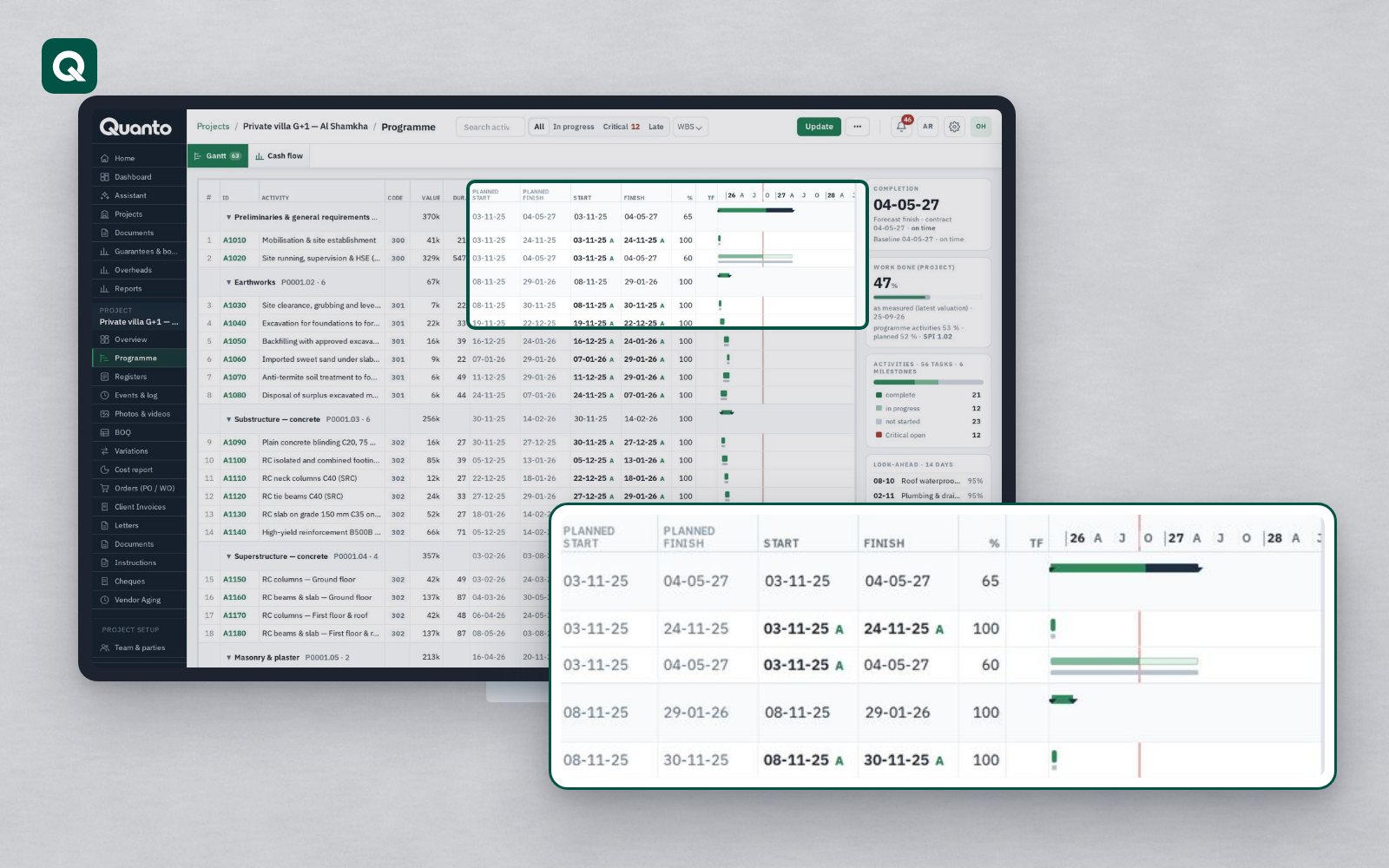
- The programme is imported from Primavera P6 or MS Project, with its baseline and progress updates. The Gantt view shows critical and late activities and a 14-day look-ahead.
- Site events come in 14 types, including delays, weather, instructions and deliveries, each with hours lost and impact.
- Photos and videos are linked to the events and programme activities they belong to.
- Claims carry the extension of time, with linked site events, photos and letters as evidence, and continuing claims take interim updates.
- Contract clocks count the notice periods of your form of contract, with a reminder two days before each deadline.
- In Business and above, time impact analysis with fragnets on the programme, and prolongation cost by head, including the Emden formula.
The planner, the site engineer and the contracts manager look at the same event. The link is made when it happens, by the people who saw it.
A short checklist
- For every delay event, note the programme activities it affects, on the day.
- Record the start and end date of each event, not only that it happened.
- Record your own delays too. A record that hides them is not believed.
- Keep the accepted baseline and every update, each with its data date.
- For each new event, check the notice period in your contract and count from the day you became aware.
Tomorrow: the wrong drawing revision on site.
General information only. Periods and procedures depend on the form of contract and its particular conditions; always check your own contract.
Follow Quanto for a new article every day: LinkedIn · X · YouTube · Instagram · Facebook