
Level 4, block work. The Engineer's inspector rejects the wall because the movement joint against the column is missing. An NCR is raised, the mason fixes it, the NCR is closed. Two weeks later, on level 6, the same inspector writes the same NCR for the same detail. Then again on level 8. Each time the wall is fixed. The reason it keeps happening is never touched.
What it costs
One NCR is a small cost: some rework, a re-inspection, a day lost on that area. The same NCR five times is a different matter. The rework repeats, the inspections repeat, and the follow-on trades wait each time. The Engineer starts to doubt the contractor's quality system as a whole, inspections get stricter, and approvals slow down across the job. Where the contract lets the certifier hold money for defective work, open NCRs also show up in the payment certificate.
A repeated block-work NCR costs AED 6,000 each time in breaking out, rebuilding and re-plastering, plus two days of delay to the plasterer on that floor. Five times over, that is AED 30,000 and ten days of disruption, for a detail that one toolbox talk and one marked-up drawing could have fixed after the first NCR.
How it is usually handled
NCRs live in an Excel log kept by the quality engineer, with the signed forms in a folder or scanned to email. The log records the number, the date and "closed". It rarely records why the problem happened or what was changed to stop it. Closing is treated as "the defect has been repaired", not "the cause has been removed".
Because each NCR sits on its own sheet, nobody reads them side by side. The site team on level 8 does not know about the NCR on level 4. A new subcontractor gang arrives and repeats the old mistake. When the Engineer asks for a corrective action report at the end of the month, someone writes it from memory.
How Quanto Management handles it
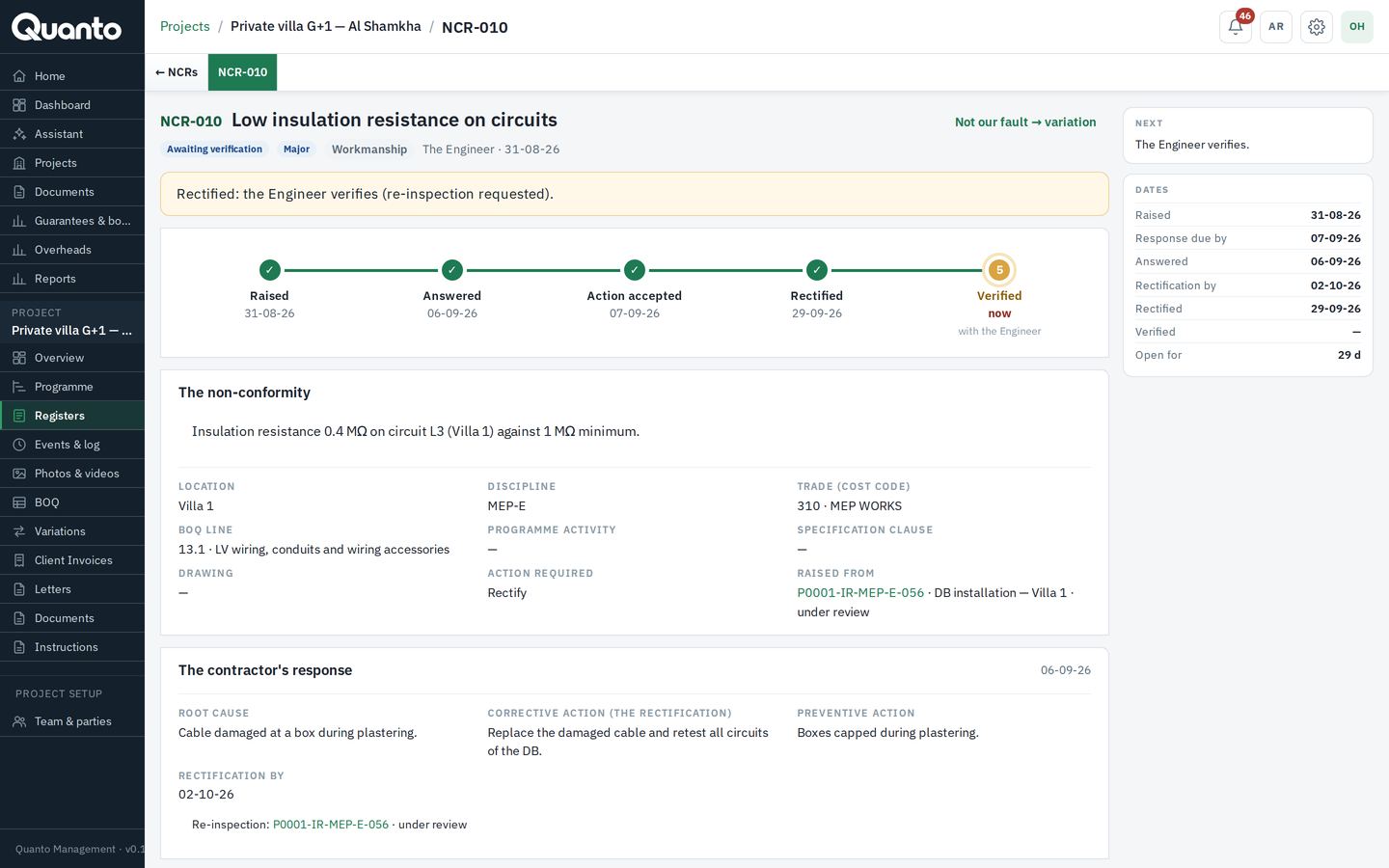
In Quanto Management, a non-conformance report follows a set path from raising to close-out: the contractor's response, the rectification, the re-inspection and the verification. The consultant issues the NCR and follows it to close; the owner receives a copy of every NCR.
- Each NCR carries its root cause and corrective action, so closing it means saying what was changed, not only what was repaired.
- All NCRs sit in one register, each with its full history, so the pattern is visible when you read them together.
- Inspections are recorded against the ITP, and an invited subcontractor sees the result and any NCR on their own inspection request, then resubmits as the next revision.
- In valuations (Professional and above), amounts held for open NCRs appear in the payment application, so an open NCR has a visible price.
The same records support an ISO 9001 system: corrective action with root cause, inspections and controlled revisions, each with its history. The certification itself stays with your certification body.
A short checklist
- Before closing any NCR, write one line on why it happened, not only how it was fixed.
- Once a month, read all open and closed NCRs together and group them by trade and defect.
- When the same defect appears twice, brief the gang and the foreman before the next area starts.
- Mark the detail on the drawing or method statement the gang actually uses.
- Check the next inspection request for that activity against the corrective action you promised.
Tomorrow: an extension-of-time claim without records.
Follow Quanto for a new article every day: LinkedIn · X · YouTube · Instagram · Facebook