
A dispute meeting, eighteen months into the project. The contractor says it gave notice of the late access in a letter. The consultant says it never received one. The contractor's commercial manager searches the shared drive and finds three versions: one in Word, one as an unsigned PDF, one scanned with a stamp nobody can read. None has a reference number. The covering email went from a site engineer's own account, and he left the company last year.
What it costs
On a construction project, letters are how rights are kept: notices, objections, reservations, replies to instructions. A letter that cannot be found, or cannot be shown to have been sent and received, is worth very little on the day it is needed. A notice may be argued to be invalid, a reply may be argued to be late, and a position taken in writing two years ago may be impossible to prove.
A contractor's notice of delay for late access supports a prolongation claim of AED 400,000. The letter exists, but without a reference, a signed copy or proof of when it was received, the other side disputes that notice was given in time. The claim now starts with an argument about paperwork instead of the delay itself.
How it is usually handled
Letters are written in Word from an old template, numbered by hand from an Excel register, signed, scanned and emailed. Each step is a chance for something to slip: a number used twice, a register not updated, a letter sent from a personal mailbox, a reply filed in a different folder from the letter it answers. Over the life of a project, with several people writing, the series becomes unreliable, and nobody can say which letters are still waiting for a reply.
The weak point is that the record depends on habits, not on the system. One busy week is enough to break the series.
How Quanto Management handles it
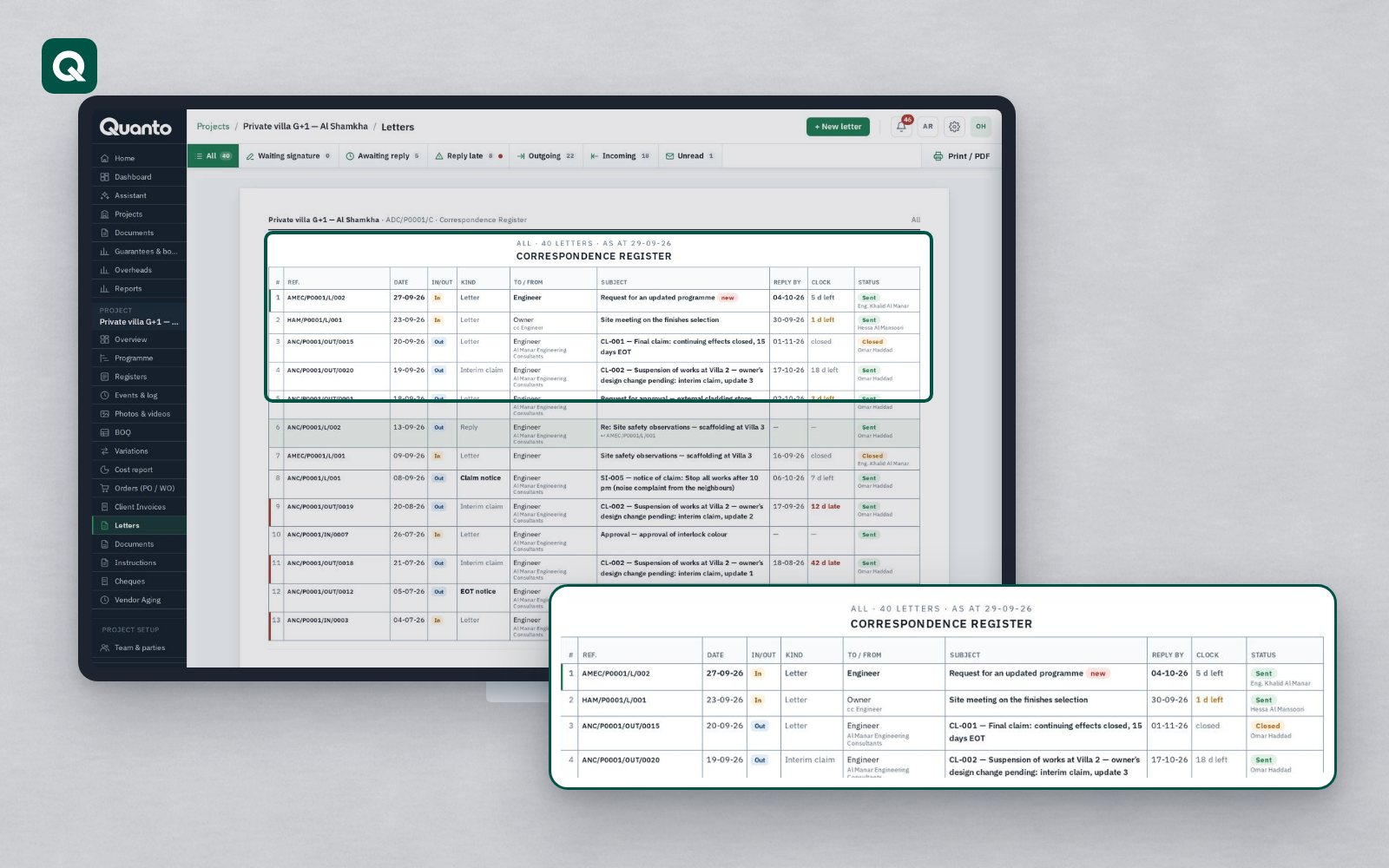
In Quanto Management, letters are written on the company letterhead and numbered from the company's own reference pattern, so every letter has its reference the moment it is created.
- A signatory signs before a letter goes out. Drafts stay with the company that wrote them until they are sent.
- Parties on Quanto receive the letter in their inbox, with read receipts.
- A letter can carry a reply-by date, and replies are kept in threads with the letter they answer.
- Photos can be linked to letters, and claims can link letters as part of their evidence.
- The project log records every action, and records are never silently deleted: changes are logged with who and when.
The correspondence then belongs to the project, not to the mailbox of whoever wrote it. When someone leaves, the letters stay, in order, with their replies.
A short checklist
- Use one reference series per project, and let no letter go out without a number.
- Keep the signed version as the record, not the draft.
- Get proof of receipt for every notice: a read receipt, a stamped copy or a signed transmittal.
- Put a reply-by date on any letter that needs an answer, and check the open ones every week.
- Quote the reference of the letter you are answering in the first line of every reply.
- Send formal letters from a project or company address, never from a personal account.
Tomorrow: cash-flow surprises.
Follow Quanto for a new article every day: LinkedIn · X · YouTube · Instagram · Facebook